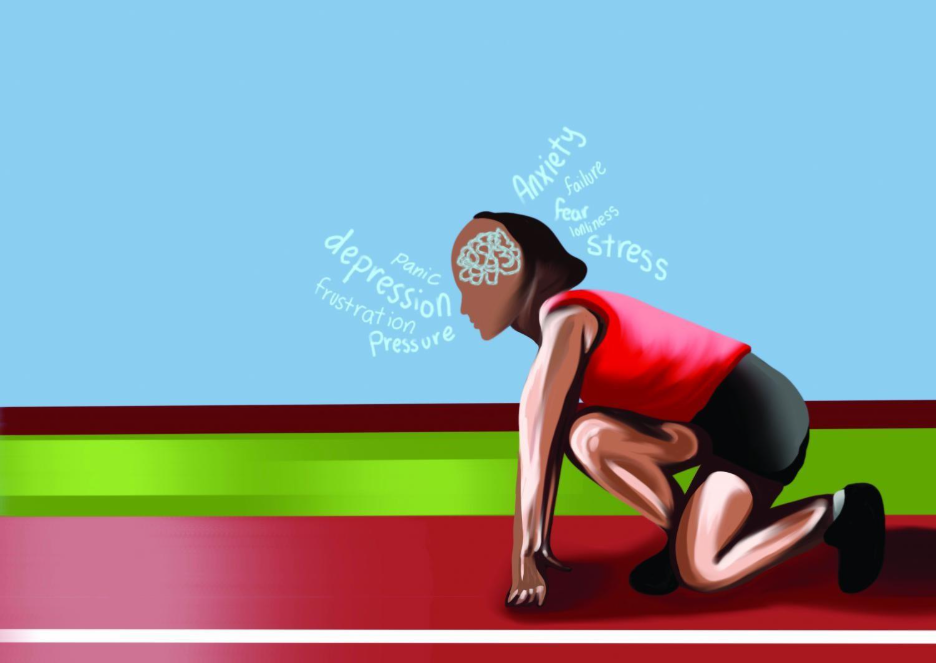
1 Illustration of sports Performance Anxiety
Picture this. A climber standing at the base of a boulder problem. They’ve mapped out the beta at least hundred times in their head. Feet here. Left hand to the crimp. Drop knee, pop to the top. They’re ready. But in the back of there mind doubt sets in.
Fear. Anxiety.
Or a golfer standing over a six-foot putt with a two-stroke lead. They’ve made it this far. It’s their game to lose and it’s starting to get in their head.
Or a professional esports player walking up to the mainstage, hands shaking before the final match for the world championship.
Different arenas. Same problem.
The thing holding all three of them back isn’t physical. It’s not a lack of preparation. It’s not technique. It’s all mental!
And it has a name. Performance anxiety. .
More people are turning to brain supplements as one piece of a broader strategy to manage their mental game. The reason why is straightforward once you understand what anxiety actually does to your output.
Your Brain Is the Playmaker
“Mental performance” gets thrown around a lot. But what does it actually mean?
It’s not just “focus” or “being in the zone.” Mental performance is a collection of cognitive functions working together in real time:
- Working memory – holding and processing information simultaneously
- Processing speed – how fast your brain evaluates a situation and responds
- Emotional regulation – managing stress, frustration, and pressure without letting it hijack your decisions
- Sustained attention – maintaining concentration over extended periods without degrading
Every sport, every performance environment, every competitive scenario pulls on all four of these at once.
The traditional approach has always been to train harder or grind until it’s automatic. And reps matter. They absolutely do. But there’s a ceiling. And that ceiling isn’t physical. It’s cognitive.
Research on performance under pressure consistently shows that cognitive load, the mental weight you’re carrying in a high-stakes moment, directly impacts decision speed and accuracy. The harder your brain is working to manage stress, the less bandwidth it has for the task itself.
You can have the sharpest mechanics in the room and still get outperformed by someone who manages their mental state better.
So what happens when anxiety enters the picture?
When Your Brain Works Against You
Here’s the part that most people don’t want to hear: anxiety is not a character flaw. It’s not weakness. It’s biology. Specifically, it’s your fight-or-flight system doing exactly what it was designed to do — just in a context it was never designed for.
Fight-or-flight was built for physical threats. Sprint from the predator. Fight back. Survive. Your nervous system doesn’t distinguish between a lion and a tournament bracket. It just detects threat and fires.
Under anxiety, research published in PLOS One confirms what performers across every discipline already feel: working memory slows down, threat-related interference increases, and the effect is even stronger in people who already carry higher baseline anxiety. Here’s what that looks like in practice:
- Attention narrows. Tunnel vision kicks in. Your brain focuses only on the perceived threat and strips away peripheral awareness. Great for escaping predators. Terrible for spatial decision-making in a game, reading a green, or committing to a sequence on the wall.
- Working memory gets disrupted. The cortisol dump that comes with anxiety actively interferes with your prefrontal cortex — the part of your brain responsible for complex decision-making and holding a plan in mind.
- Reaction time slows. Counter-intuitive but true. The cognitive overhead of managing an anxious state eats into the processing speed you need for fast responses.
- Sleep degrades. And here’s where it compounds. Chronic performance anxiety disrupts sleep quality, which in turn tanks cognitive function the next day. It feeds itself.
This isn’t weakness. This is a system misfiring in a context it wasn’t designed for. And because it’s a system, it’s manageable.
But it doesn’t stay in your head.
The Mind-Body Pipeline Is Real
Anxiety doesn’t live exclusively between your ears. It has a very physical symptoms.
Cognitive stress triggers real physiological responses: muscle tension, shallow breathing, elevated heart rate, reduced fine motor control. The mental and the physical aren’t two separate categories, they’re the same system working together in tandem.
Mental v Physical Performance
Climbing is the most obvious case study.
Ask any climber and they’ll tell you about sewing machine leg. The uncontrollable shaking that hits when you’re committed on a high ball, pumped out of your mind, and your nervous system decides right now is the perfect time to vibrate your foot off the hold.
But sewing machine leg isn’t just physical fatigue. It’s anxiety expressing itself through your body. The beta is dialed. The strength is there. But the moment your brain registers consequence — height, a hard fall zone, a crux sequence you’re not sure you can stick — it tightens your grip, stiffens your movement, and pulls your breathing shallow. Suddenly the move that felt completely manageable on the ground feels impossible at height.
At a certain level, mental state IS technique.
Golf makes the same argument, just in slow motion.
Golf is probably the purest mental performance sport in existence. The swing is built over thousands of hours of repetition. The mechanics are second nature. What breaks down on the course is never the swing, it’s the unsettling thoughts in your head. The scorecard math you’re doing when you should be focused on the next swing.
Every golfer will tell you the game is 90% mental. And yet most of them still struggle to play like they actually believe that.
Tight muscles, shallow breathing, these are not mechanical failures. They are outputs of a mental state that has gone unchecked. You can’t stretch your way out of that. You can’t warm up enough to override it.
Managing the mind manages the body. That’s the pipeline.
Esports Athletes: Performance Pressure at the Highest Level
Esports doesn’t get the respect it deserves as a performance environment. But from a cognitive demand standpoint, it’s as rigorous as it gets.
Reaction times measured in milliseconds. Matches that run hours. Decision trees that would make a chess player sweat. Team communication that has to stay sharp and coordinated even when fatigue and pressure are stacking. Map awareness, meta adaptation, target prioritization — all running simultaneously, all at the highest possible speed.
And the anxiety? It’s everywhere.
The “tilt” phenomenon is especially worth understanding. Tilt is a direct anxiety response. One bad round, one bad decision, one flame in the chat and the emotional composure breaks down. Suddenly you’re playing reactive instead of strategic. Sound familiar? It should. It’s the same mechanisms the golfer pressing on the back nine or the climber second-guessing their beta.
A peer-reviewed systematic review on esports and stress found that competitive players face the same mental conditions as traditional pro athletes in high-profile tournaments — communication pressure, live audience anxiety, and chronic performance stress.
We’ve covered this in depth before: if you haven’t read our piece on avoiding burnout and maintaining gaming focus, it’s worth the read alongside this one.
The top esports organizations have figured this out. Sports psychologists on staff. Structured mental performance protocols. Mandatory recovery windows. The field caught up to what golf and climbing coaches have known for decades — cognitive health isn’t optional at elite levels. It’s infrastructure.
Whether you’re competing on a wall, a course, or a screen, the mental performance breakdown follows the same pattern.
Where Brain Supplements Fit In

2 Alex Honnold climbing Taipei 101
Not everyone is a fearless freak like Alex Honnold. the man feels nothing.
Let’s be direct about what a brain supplement is and what it isn’t.
It is not a performance cheat code. It is not a substitute for preparation, sleep, or the mental repetitions required to actually deal with pressure. If you are not sleeping, not fueling your body, and not putting in the work, there isn’t any supplement that is going to make up for the lack of.
Seriously though, eat food and get sleep!
What a brain supplement can do is support the cognitive system you have already built. Think of it as infrastructure for your infrastructure. Or a supplement. Cause that’s precisely what it is. Not a short cut or magic potion.
The ingredients that show up in legitimate cognitive support formulas address the specific mechanisms that performance anxiety targets:
- Adaptogens like Ashwagandha and Rhodiola work on the cortisol response. The same hormonal drop that triggers the fight-or-flight response.
A randomized, double-blind, placebo-controlled clinical trial of 130 stressed adults found that Ashwagandha supplementation over 90 days significantly improved recall memory, reduced cortisol levels, lowered perceived stress scores, and improved sleep quality compared to placebo.
- L-Theanine promotes calm alertness where you’re sharp and focused without the edge of anxiety.
- Bacopa Monnieri has a history of supporting working memory and information processing. What tends to get disrupted when cognitive load spikes under pressure.
- L-Tyrosine is the predecessor to dopamine and norepinephrine. Under stressful conditions, these neurotransmitters get depleted. L-Tyrosine helps maintain that pathway when your system is under load.
For climbers, it is specific to a situation. Staying mentally focused, suppressing the fear response, maintaining technique and decision making on a move where you may or may not be freaking out.
For golfers, keeping your mental in check despite wind conditions or that slope not cooperating with your putt. Maybe saving face when deep down you want to rage and fling that club into the lake.
For esports athletes, sustained reaction time across long sessions, hand eye coordination, and maintaining composure when the series is on the line.
IgniteFocus was built around performance-under-pressure scenarios specifically — not just general “energy.” Most energy products are trying to solve tiredness. A brain supplement is trying to solve the system. That’s a different problem requiring a different approach.
Where Brain Supplements Fit In
Here’s the honest framework. Supplements are one layer. They are not the foundation.
The foundation looks like this:
- Protect your peak performance windows. Identify when you perform best — time of day, environment, mental state — and build your preparation around arriving at those windows ready.
- Build a pre-performance routine and actually use it. Elite climbers visualize a sequence before they leave the ground. Tour-level golfers have a pre-shot routine they execute on every single shot, regardless of the stakes. Top esports players have warmup protocols. Consistency in routine reduces the variance that anxiety exploits.
- Sleep is non-negotiable. Cognitive function, emotional regulation, reaction time, working memory — all of it degrades without quality sleep. No supplement compensates for chronic sleep debt. Full stop.
- Supplementation supports the system. Once the foundation is in place, a well-formulated brain supplement helps you arrive at the performance moment in the optimal cognitive state to actually execute.
The goal is to show up with everything you’ve built, intact.
Your Output Starts Upstairs
Back to those three scenarios. The climber frozen at the base. The golfer over the putt. The player with the shaking hands.
Every one of those moments is a mental performance problem first. The body is ready. The preparation is done. What’s failing is the bridge between capability and execution under pressure.
Managing performance means managing that bridge. That’s sleep, routine, mental reps, and yes — the cognitive support that keeps your system running at the level your preparation deserves.
IgniteFocus isn’t promising to eliminate the pressure. Pressure is part of competition. It’s part of what makes those moments worth anything. What IgniteFocus is built to do is help you function inside it — so the climber starts the problem, the golfer makes the putt, and the player plays their game.
Leave a Reply