Performance tools work best when they are used with intention. Whether you are studying for finals, grinding ranked matches, or pushing through a demanding work shift, the way you use cognitive support matters just as much as what you use. That is the conversation most supplement brands avoid because it is easier to sell the promise than to explain the responsibility. We would rather do both.
IgniteFocus was built as one of the few genuine safe vape alternatives on the market. It looks like a vape, delivers like a vape, and satisfies the same physical habit loop that makes nicotine products so hard to quit. But it contains no nicotine, no carcinogens, and no addictive compounds. That distinction means something. And it comes with a responsibility to use the product in a way that honors it.
What Responsible Use Actually Means
Responsible use is not a disclaimer. It is a framework for getting the most out of any performance tool without building dependency, undermining your health, or using the product as a substitute for things it was never designed to replace.
For IgniteFocus, responsible use means three things: using it intentionally rather than habitually, treating it as one layer of a larger system rather than the whole system, and staying honest with yourself about whether it is serving you or becoming a crutch.
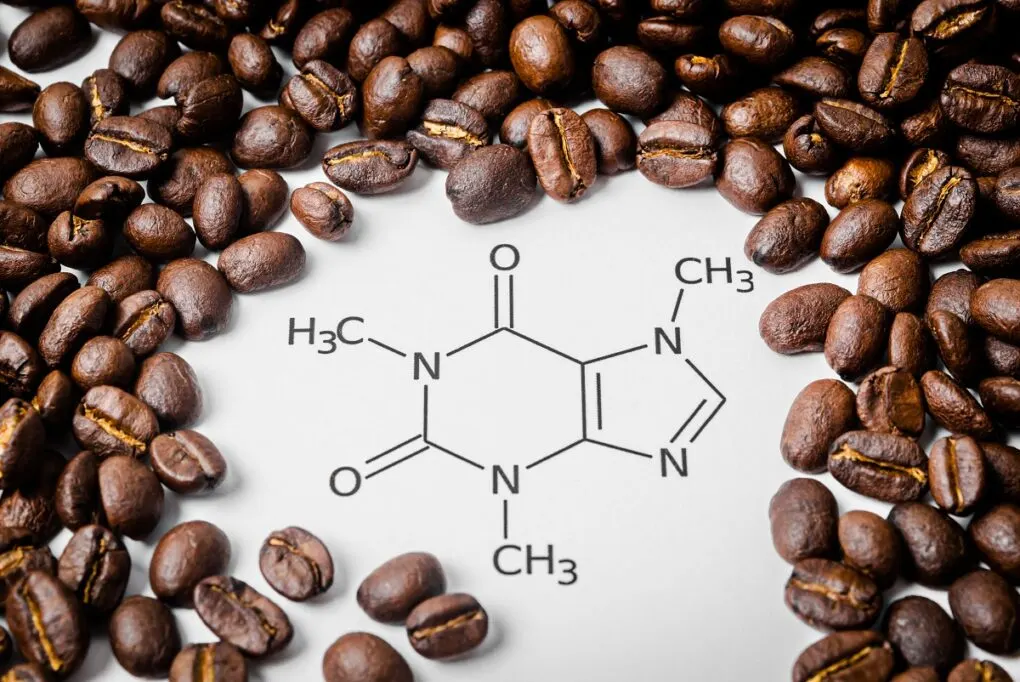
Caffeine, even natural caffeine delivered cleanly, is still a stimulant. The research on caffeine and cognitive performance is clear that optimal dosing outperforms maximum dosing. Low to moderate doses sharpen attention and improve sustained focus. High doses or excessive frequency introduce anxiety, impaired executive function, and tolerance buildup that reduces effectiveness over time.
The goal is not to use IgniteFocus as much as possible. The goal is to use it well.
Why the Vape Replacement Angle Matters
One of the most common reasons people reach for a vape is not the nicotine high itself. It is the habit loop: something to hold during a stressful moment, a physical ritual before a hard task, a sensory anchor during long sessions. That loop is real, and cold turkey quitting fails so often partly because it removes the loop without replacing it.
IgniteFocus was designed specifically as one of the most functional vape replacements available because it preserves the physical ritual while removing everything harmful from it. The act of inhaling something before a focus session, the hand-to-mouth habit, the sensory cue that tells your brain it is time to perform: all of that remains. What goes away is the nicotine, the carcinogens, and the addictive dependency that follows.
Nicotine is not only a well-documented carcinogen. It causes measurable harm to the heart, lungs, reproductive system, and liver. The inflated sense of energy and focus it provides is borrowed, not generated. When you stop using it, that energy disappears and the withdrawal makes everything harder. That is the trap. IgniteFocus does not work that way. The natural caffeine supports your existing cognitive system. It does not hijack it.
As a non-toxic vape alternative, IgniteFocus gives people a real exit path from nicotine dependency, not just a willpower challenge with no support.
Building the System Around the Tool
No performance tool, including IgniteFocus, works well in isolation. The most consistent focus and energy come from a foundation that includes sleep, nutrition, structured planning, and stress management. A supplement supports that foundation. It does not replace it.
If you have not already, our post on time management for students during high-pressure semesters lays out how to build that foundation step by step. The productivity framework there is what makes a focus supplement actually useful. Without it, you are just adding stimulation to a system that is already overloaded.
The same principle applies to managing performance and anxiety. High-dose caffeine can worsen anxiety symptoms, which directly undermines the cognitive performance you are trying to support. Responsible use means knowing your baseline and not pushing past it when your nervous system is already under load.
Practical Guidelines for Responsible Use
Use IgniteFocus before a defined work block, not reactively when you are already behind or already anxious.
Start with less than you think you need. The aerosol delivery is faster than coffee or energy drinks. Give it time to settle before taking more.
Do not stack it with other stimulants. Combining caffeine sources increases dose unpredictably and raises the risk of overstimulation.
Take breaks from it. Tolerance builds with any caffeine product. Scheduled days off help reset your baseline and keep the product effective.
Pay attention to your sleep. If IgniteFocus is affecting your ability to fall asleep, you are using it too late in the day or too frequently.
For gamers and streamers specifically, our post on avoiding burnout and maintaining gaming focus covers how to integrate performance support into long sessions without tipping into dependency or physical burnout. The same principles apply whether you are studying or competing.
The Honest Bottom Line
IgniteFocus is one of the most carefully designed safe vape alternatives available. It gives you the physical habit loop that vaping satisfies, the fast-acting energy that energy drinks promise but rarely deliver cleanly, and the absence of everything that makes those products genuinely harmful.
But it is still a tool. Tools work when they are used correctly. Used correctly, IgniteFocus supports focus, helps break nicotine dependency, and fits into a performance routine that actually holds up under pressure. Used carelessly, any caffeinated product stops working the way you need it to.
We would rather tell you that honestly upfront than have you figure it out after the fact. That is what responsible use looks like from our side. The rest is up to you.
Ask any college student what their biggest challenge is, and you will hear some version of the same answer: there is too much to do, and never enough mental energy to do it. Productivity for students is not an abstract concept. It is the difference between keeping up and falling behind, between performing at your best and grinding through on fumes. If that second scenario sounds familiar, it may be worth reading about what academic fatigue actually is and how to overcome it before diving into tools.
Ask any college student what their biggest challenge is, and you will hear some version of the same answer: there is too much to do, and never enough mental energy to do it. Productivity for students is not an abstract concept. It is the difference between keeping up and falling behind, between performing at your best and grinding through on fumes. If that second scenario sounds familiar, it may be worth reading about what academic fatigue actually is and how to overcome it before diving into tools.
Why Students Struggle to Stay Productive
Productivity problems in college are rarely about laziness. Most students want to succeed, but they just face a combination of structural challenges that make sustained focus difficult:
Fragmented schedules that break concentration before it builds
Chronic sleep debt that degrades decision-making and working memory
Digital environments designed to capture attention, not protect it
Mounting academic and financial pressure that raises baseline stress
Little to no training in how to manage cognitive load effectively
Understanding these root causes matters because it shapes how you approach solutions. The goal is not to work harder. It is to work smarter within a system that actually supports focus.
The Productivity Stack: Tools That Actually Work
No single tool solves the productivity problem. What works is a layered system, with different tools addressing different friction points in your day.
1. Digital Planning and Scheduling Tools
The foundation of any productive student routine is a clear picture of what needs to happen and when. Apps like Notion, Google Calendar, and Todoist allow you to externalize your workload so your brain is not constantly tracking deadlines in the background.
The key is not just using a planner. It is using it consistently. Set up a weekly skeleton at the start of each week: block your classes, your deep work sessions, your meals, and your recovery time. When your day is pre-decided, you spend less cognitive energy figuring out what to do next and more on actually doing it. For a deeper look at this approach, see our guide on time management for students during high-pressure semesters.
2. Time-Boxing and Focus Timers
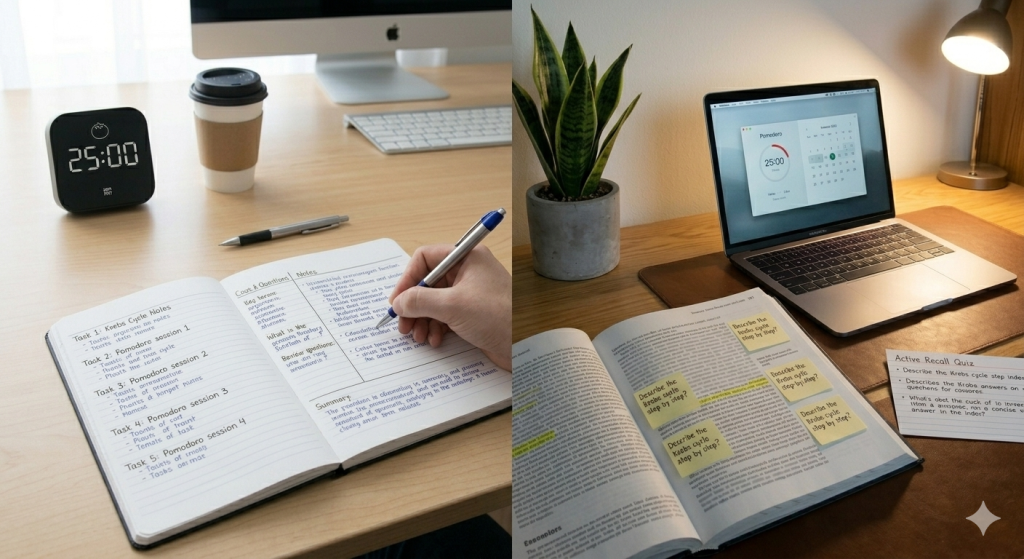
Studying without a defined end point is one of the fastest ways to lose focus. The Pomodoro Technique, which involves working in focused 25-minute intervals followed by short breaks, has strong research support for improving sustained attention and reducing mental fatigue.
Apps like Forest, Be Focused, and Toggl Track make this easy to implement. The psychological effect of a countdown timer should not be underestimated: it creates urgency and closure in a way that an open-ended “I will study until I feel done” approach cannot.
3. Distraction Blocking and Environmental Design
Your environment shapes your behavior more than willpower does. Tools like Freedom, Cold Turkey, and even your phone’s built-in focus modes can block distracting apps and sites during work sessions, removing the option to drift before the habit of drifting forms.
Physical environment matters too. A dedicated study space, good lighting, noise-canceling headphones, and removing clutter all reduce the low-level cognitive friction that erodes focus over time. This applies just as much to gamers and content creators as it does to students in a library. Our post on avoiding burnout and maintaining gaming focus covers the environmental side of sustained performance in detail.
4. Note-Taking Systems That Reduce Cognitive Load
Re-reading is one of the least effective study strategies, yet it is what most students default to when they are tired. Replacing passive re-reading with active recall, which means retrieving information from memory rather than looking at it again, significantly improves retention and reduces the total time needed to learn material.
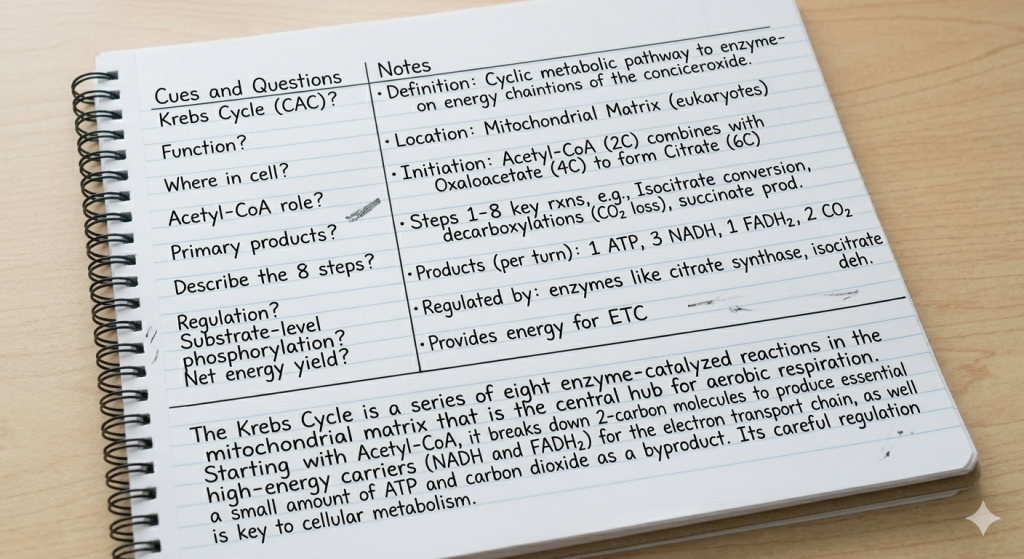
Systems like the Cornell note-taking method, spaced repetition via Anki, and the Feynman technique (explaining concepts in plain language to test understanding) all support this. When your study methods are more efficient, you spend less total time working for the same or better results.
Where Focus Medicine Fits In
Once a student has built a solid foundation (a planned schedule, a structured environment, and efficient study methods), focus medicine becomes a meaningful conversation.
Focus medicine refers to products designed to support sustained attention, alertness, and mental clarity during demanding cognitive tasks. The category includes everything from caffeine-based supplements to nootropic stacks that target specific aspects of cognitive performance. If you want to understand what the science actually says about caffeine and the brain, our piece on caffeine and cognitive performance goes deep on dose, timing, and delivery. The key distinction is this:
Focus medicine supports a system that already works. It does not build the system for you.
It helps you arrive at your study block ready to work. It does not replace the planning, sleep, and structure that make the study block productive.
Used responsibly, focus medicine can be a legitimate layer of a student’s productivity system. Used as a substitute for sleep or structured habits, it delivers diminishing returns and often makes the underlying problems worse.
Final Thoughts
Staying on track as a student is not about finding one perfect tool or supplement. It is about building a layered system planning that eliminates decision fatigue, an environment that reduces distraction, study methods that maximize efficiency, and cognitive support that helps you perform at your best inside the structure you have built.
Focus medicine, used correctly, is one piece of that system. A legitimate piece but not the whole picture. The students who consistently outperform are not the ones who push hardest. They are the ones who show up most consistently, most recovered, and most prepared. If you are looking for a practical starting point, our post on a more realistic way to get through long study sessions walks through exactly how IgniteFocus fits into a real student routine.
Build the system first. Then use every tool available to protect it.
Focus medicine has become an increasingly discussed topic among students looking for ways to stay on track during demanding academic schedules. Between assignments, exams, jobs, and personal responsibilities, maintaining consistent productivity can feel overwhelming. Many students search for tools and strategies to improve focus, and understanding what actually works can make a significant difference.
Why Students Struggle to Stay on Track
Staying productive in college isn’t just about motivation, it’s about managing time, energy, and mental clarity. Students often face:
Constant distractions from phones and social media
Irregular sleep schedules
High levels of stress
Overloaded schedules
These challenges make it difficult to maintain consistent focus, leading many students to look into productivity tools and even solutions like focus medicine or an otc medicine to help focus.
However, productivity is rarely solved by a single solution. It requires a combination of tools and habits working together.
Types of Productivity Tools That Actually Work
There are several categories of tools that can help students stay on track. Each serves a different purpose, and when combined, they can significantly improve academic performance.
1. Digital Planning Tools
Apps like Google Calendar, Notion, and Todoist help students organize their schedules and deadlines in one place. These tools allow you to break large assignments into smaller, manageable tasks.
When students can visually see their workload, it reduces stress and improves follow-through.
2. Focus and Timer Apps
Tools like Pomodoro timers help students work in focused intervals. Instead of trying to study for hours straight, students work in short bursts with scheduled breaks.
This approach helps reduce mental fatigue and improves retention.
3. Distraction Blockers
Apps such as Freedom or Cold Turkey temporarily block distracting websites and apps. This creates a controlled environment where students can focus on their work without interruptions.
Distraction blockers are especially helpful for students who struggle with social media during study sessions.
4. Physical Study Tools
Not all productivity tools are digital. Physical tools such as planners, whiteboards, and sticky notes can help reinforce structure and accountability.
Some students retain information better when writing things down, making physical tools a valuable addition.
Where Focus Medicine Fits In
While productivity tools help with organization and structure, some students also explore options like focus medicine or otc medicine to help focus as part of their routine.
These products are typically designed to support alertness and concentration, often using caffeine or other ingredients that stimulate mental activity. However, it is important to understand that these are not replacements for good habits.
Focus medicine should be viewed as a supplement to:
Proper sleep
Balanced nutrition
Time management
Stress control
Without these foundations, no productivity tool, including focus medicine, will be fully effective.
The Risks of Relying on Quick Fixes
Many students fall into the habit of relying too heavily on quick solutions. Energy drinks, excessive caffeine, and certain medications may provide short-term results, but they can also lead to:
Energy crashes
Increased anxiety
Poor sleep quality
Decreased long-term productivity
According to the Centers for Disease Control and Prevention, sleep deprivation and stimulant overuse can negatively impact cognitive performance.
This is why balance is critical when considering any productivity support method.
Building a Sustainable Productivity System
The most effective approach is combining tools and habits into a system that supports consistency.
A strong system might include:
A digital planner for organization
A timer for structured study sessions
A distraction blocker for focus
Healthy routines for sleep and nutrition
Occasional use of focus medicine when needed
When these elements work together, students can maintain steady productivity instead of relying on last-minute effort.
Why Consistency Matters More Than Intensity
One of the biggest misconceptions about productivity is that it requires intense bursts of effort. In reality, consistency is far more important.
Students who build steady routines tend to:
Retain more information
Experience less stress
Perform better over time
Productivity tools and focus medicine can support this consistency, but they are most effective when used responsibly and as part of a balanced approach.
Final Thoughts
Staying on track in college is not about finding a single perfect solution. It is about creating a system that supports focus, energy, and organization over time. By combining productivity tools with healthy habits and responsible use of options like otc medicine to help focus, students can improve their performance without burnout.
If used correctly, focus medicine can be one piece of a larger strategy, but the real key to success is consistency and balance.
What productivity tools have helped you stay on track during school? Share your experience in the comments, your tips could help other students improve their focus.
Picture this. A climber standing at the base of a boulder problem. They’ve mapped out the beta at least hundred times in their head. Feet here. Left hand to the crimp. Drop knee, pop to the top. They’re ready. But in the back of there mind doubt sets in.
Fear. Anxiety.
Or a golfer standing over a six-foot putt with a two-stroke lead. They’ve made it this far. It’s their game to lose and it’s starting to get in their head.
Or a professional esports player walking up to the mainstage, hands shaking before the final match for the world championship.
Different arenas. Same problem.
The thing holding all three of them back isn’t physical. It’s not a lack of preparation. It’s not technique. It’s all mental!
And it has a name. Performanceanxiety. .
More people are turning to brain supplements as one piece of a broader strategy to manage their mental game. The reason why is straightforward once you understand what anxiety actually does to your output.
Your Brain Is the Playmaker
“Mental performance” gets thrown around a lot. But what does it actually mean?
It’s not just “focus” or “being in the zone.” Mental performance is a collection of cognitive functions working together in real time:
Working memory – holding and processing information simultaneously
Processing speed – how fast your brain evaluates a situation and responds
Emotional regulation – managing stress, frustration, and pressure without letting it hijack your decisions
Sustained attention – maintaining concentration over extended periods without degrading
Every sport, every performance environment, every competitive scenario pulls on all four of these at once.
The traditional approach has always been to train harder or grind until it’s automatic. And reps matter. They absolutely do. But there’s a ceiling. And that ceiling isn’t physical. It’s cognitive.
Research on performance under pressure consistently shows that cognitive load, the mental weight you’re carrying in a high-stakes moment, directly impacts decision speed and accuracy. The harder your brain is working to manage stress, the less bandwidth it has for the task itself.
You can have the sharpest mechanics in the room and still get outperformed by someone who manages their mental state better.
So what happens when anxiety enters the picture?
When Your Brain Works Against You
Here’s the part that most people don’t want to hear: anxiety is not a character flaw. It’s not weakness. It’s biology. Specifically, it’s your fight-or-flight system doing exactly what it was designed to do — just in a context it was never designed for.
Fight-or-flight was built for physical threats. Sprint from the predator. Fight back. Survive. Your nervous system doesn’t distinguish between a lion and a tournament bracket. It just detects threat and fires.
Under anxiety, research published in PLOS One confirms what performers across every discipline already feel: working memory slows down, threat-related interference increases, and the effect is even stronger in people who already carry higher baseline anxiety. Here’s what that looks like in practice:
Attention narrows. Tunnel vision kicks in. Your brain focuses only on the perceived threat and strips away peripheral awareness. Great for escaping predators. Terrible for spatial decision-making in a game, reading a green, or committing to a sequence on the wall.
Working memory gets disrupted. The cortisol dump that comes with anxiety actively interferes with your prefrontal cortex — the part of your brain responsible for complex decision-making and holding a plan in mind.
Reaction time slows. Counter-intuitive but true. The cognitive overhead of managing an anxious state eats into the processing speed you need for fast responses.
Sleep degrades. And here’s where it compounds. Chronic performance anxiety disrupts sleep quality, which in turn tanks cognitive function the next day. It feeds itself.
This isn’t weakness. This is a system misfiring in a context it wasn’t designed for. And because it’s a system, it’s manageable.
But it doesn’t stay in your head.
The Mind-Body Pipeline Is Real
Anxiety doesn’t live exclusively between your ears. It has a very physical symptoms.
Cognitive stress triggers real physiological responses: muscle tension, shallow breathing, elevated heart rate, reduced fine motor control. The mental and the physical aren’t two separate categories, they’re the same system working together in tandem.
Mental v Physical Performance
Climbing is the most obvious case study.
Ask any climber and they’ll tell you about sewing machine leg. The uncontrollable shaking that hits when you’re committed on a high ball, pumped out of your mind, and your nervous system decides right now is the perfect time to vibrate your foot off the hold.
But sewing machine leg isn’t just physical fatigue. It’s anxiety expressing itself through your body. The beta is dialed. The strength is there. But the moment your brain registers consequence — height, a hard fall zone, a crux sequence you’re not sure you can stick — it tightens your grip, stiffens your movement, and pulls your breathing shallow. Suddenly the move that felt completely manageable on the ground feels impossible at height.
At a certain level, mental state IS technique.
Golf makes the same argument, just in slow motion.
Golf is probably the purest mental performance sport in existence. The swing is built over thousands of hours of repetition. The mechanics are second nature. What breaks down on the course is never the swing, it’s the unsettling thoughts in your head. The scorecard math you’re doing when you should be focused on the next swing.
Every golfer will tell you the game is 90% mental. And yet most of them still struggle to play like they actually believe that.
Tight muscles, shallow breathing, these are not mechanical failures. They are outputs of a mental state that has gone unchecked. You can’t stretch your way out of that. You can’t warm up enough to override it.
Managing the mind manages the body. That’s the pipeline.
Esports Athletes: Performance Pressure at the Highest Level
Esports doesn’t get the respect it deserves as a performance environment. But from a cognitive demand standpoint, it’s as rigorous as it gets.
Reaction times measured in milliseconds. Matches that run hours. Decision trees that would make a chess player sweat. Team communication that has to stay sharp and coordinated even when fatigue and pressure are stacking. Map awareness, meta adaptation, target prioritization — all running simultaneously, all at the highest possible speed.
And the anxiety? It’s everywhere.
The “tilt” phenomenon is especially worth understanding. Tilt is a direct anxiety response. One bad round, one bad decision, one flame in the chat and the emotional composure breaks down. Suddenly you’re playing reactive instead of strategic. Sound familiar? It should. It’s the same mechanisms the golfer pressing on the back nine or the climber second-guessing their beta.
A peer-reviewed systematic review on esports and stress found that competitive players face the same mental conditions as traditional pro athletes in high-profile tournaments — communication pressure, live audience anxiety, and chronic performance stress.
The top esports organizations have figured this out. Sports psychologists on staff. Structured mental performance protocols. Mandatory recovery windows. The field caught up to what golf and climbing coaches have known for decades — cognitive health isn’t optional at elite levels. It’s infrastructure.
Whether you’re competing on a wall, a course, or a screen, the mental performance breakdown follows the same pattern.
Where Brain Supplements Fit In
2 Alex Honnold climbing Taipei 101
Not everyone is a fearless freak like Alex Honnold. the man feels nothing.
Let’s be direct about what a brain supplement is and what it isn’t.
It is not a performance cheat code. It is not a substitute for preparation, sleep, or the mental repetitions required to actually deal with pressure. If you are not sleeping, not fueling your body, and not putting in the work, there isn’t any supplement that is going to make up for the lack of.
Seriously though, eat food and get sleep!
What a brain supplement can do is support the cognitive system you have already built. Think of it as infrastructure for your infrastructure. Or a supplement. Cause that’s precisely what it is. Not a short cut or magic potion.
The ingredients that show up in legitimate cognitive support formulas address the specific mechanisms that performance anxiety targets:
Adaptogens like Ashwagandha and Rhodiola work on the cortisol response. The same hormonal drop that triggers the fight-or-flight response.
A randomized, double-blind, placebo-controlled clinical trial of 130 stressed adults found that Ashwagandha supplementation over 90 days significantly improved recall memory, reduced cortisol levels, lowered perceived stress scores, and improved sleep quality compared to placebo.
L-Theanine promotes calm alertness where you’re sharp and focused without the edge of anxiety.
Bacopa Monnieri has a history of supporting working memory and information processing. What tends to get disrupted when cognitive load spikes under pressure.
L-Tyrosine is the predecessor to dopamine and norepinephrine. Under stressful conditions, these neurotransmitters get depleted. L-Tyrosine helps maintain that pathway when your system is under load.
For climbers, it is specific to a situation. Staying mentally focused, suppressing the fear response, maintaining technique and decision making on a move where you may or may not be freaking out.
For golfers, keeping your mental in check despite wind conditions or that slope not cooperating with your putt. Maybe saving face when deep down you want to rage and fling that club into the lake.
For esports athletes, sustained reaction time across long sessions, hand eye coordination, and maintaining composure when the series is on the line.
IgniteFocus was built around performance-under-pressure scenarios specifically — not just general “energy.” Most energy products are trying to solve tiredness. A brain supplement is trying to solve the system. That’s a different problem requiring a different approach.
Where Brain Supplements Fit In
Here’s the honest framework. Supplements are one layer. They are not the foundation.
The foundation looks like this:
Protect your peak performance windows. Identify when you perform best — time of day, environment, mental state — and build your preparation around arriving at those windows ready.
Build a pre-performance routine and actually use it. Elite climbers visualize a sequence before they leave the ground. Tour-level golfers have a pre-shot routine they execute on every single shot, regardless of the stakes. Top esports players have warmup protocols. Consistency in routine reduces the variance that anxiety exploits.
Sleep is non-negotiable. Cognitive function, emotional regulation, reaction time, working memory — all of it degrades without quality sleep. No supplement compensates for chronic sleep debt. Full stop.
Supplementation supports the system. Once the foundation is in place, a well-formulated brain supplement helps you arrive at the performance moment in the optimal cognitive state to actually execute.
The goal is to show up with everything you’ve built, intact.
Your Output Starts Upstairs
Back to those three scenarios. The climber frozen at the base. The golfer over the putt. The player with the shaking hands.
Every one of those moments is a mental performance problem first. The body is ready. The preparation is done. What’s failing is the bridge between capability and execution under pressure.
Managing performance means managing that bridge. That’s sleep, routine, mental reps, and yes — the cognitive support that keeps your system running at the level your preparation deserves.
IgniteFocus isn’t promising to eliminate the pressure. Pressure is part of competition. It’s part of what makes those moments worth anything. What IgniteFocus is built to do is help you function inside it — so the climber starts the problem, the golfer makes the putt, and the player plays their game.
Time management for students becomes most important when the semester gets crowded, your energy drops, and every assignment feels urgent at the same time. In high-pressure seasons, the problem usually is not laziness. The problem is that your day gets filled by whatever is loudest, instead of whatever matters most.
That is why the best approach is not just better planning. It is better planning paired with better energy control. A product like IgniteFocus can fit into that conversation as a small “micro-boost” tool, but only if it supports a system you already built. For a stronger foundation, students can start with resources on building a personalized schedule from Harvard Summer School and then apply those ideas to their own week. (Harvard Summer School)
Time Management for Students Starts With a Weekly Skeleton
The fastest way to improve time management for students is to stop making decisions in the middle of chaos. Instead of waking up and hoping the day works, build a weekly skeleton ahead of time.
If IgniteFocus appears in the routine, it should appear during a preplanned deep work session. It should not become the reason you begin the task in the first place.
Use Time Blocks Instead of a Giant To-Do List
A to-do list stores tasks, but it does not tell you when those tasks will happen. That is why students often feel busy all day and still finish almost nothing important.
A stronger method is to sort work into blocks:
Deep Work
Use these blocks for tasks that require concentration, such as essay drafting, difficult homework, or exam prep.
Shallow Work
Use these for readings, formatting, discussion posts, and email.
Recovery
Use these blocks for meals, quick walks, resetting your desk, or stepping away before your next push.
Protect Your Peak Hours for Harder Work
One reason time management for students breaks down is that students schedule their day as if every hour feels the same. It does not. Most people have a better window for demanding work and a weaker window for review or maintenance.
A simple system looks like this:
Peak window: hardest academic tasks
Lower-energy window: flashcards, submission checks, outlining, and review
If IgniteFocus is part of the routine, it makes the most sense near the start of your peak work block. It should support the block you chose, not rescue a distracted hour.
Night Shift Focus Needs Anchors, Not Perfection
Students with work shifts, especially night shifts, need anchors more than they need perfect routines. Trying to copy a traditional daytime schedule usually creates more frustration.
Good time management for students is not just about motivation. It is also about environment. When distractions stay one click away, they will keep interrupting your work.
IgniteFocus Should Support the Plan, Not Replace It
A fictional product like IgniteFocus works best as a supporting detail inside a bigger system. It should not become a crutch for procrastination, all-nighters, or poor planning.
A healthier order looks like this:
plan the study block first
start the task, even for five minutes
use a small support tool only to sustain the routine
That distinction matters. If you can only begin work after reaching for a product, the real issue is probably the system around the task. Good planning, realistic scheduling, and better study habits will always matter more than a temporary boost.
A Simple Daily Template for High-Pressure Students
Here is one example of a class-heavy day:
9:00–10:30 Deep work
10:30–11:00 Recovery
11:00–2:00 Classes
2:30–3:15 Shallow work
3:15–4:00 Meal or walk
4:00–5:00 Deep work
Evening Planned leisure block
This kind of structure gives you work time, recovery time, and a cleaner mental boundary between responsibility and downtime.
Final Thoughts on Time Management for Students
The biggest improvement in time management for students comes from building a system that tells you what to do, when to do it, and how to protect that time once it starts. IgniteFocus can fit into that system as a fictional micro-boost tool, but the real advantage comes from planning, blocking, and protecting your focus.